I'm Ji Zhou, and I also go by Collin. I'm a computational physicist developing high-fidelity simulations and physics-informed multi-agent models to study biological locomotion, hydrodynamic interactions, and collective behavior.
My research uses high-fidelity simulations and interpretable computational models to study biological locomotion and collective dynamics. This work includes a physics-informed agent-based model that connects social interaction rules with hydrodynamic wake effects.
Direct numerical simulationPhysics-informed multi-agent modelsActive-learning researchLarge-scale simulation workflows
Journal of Fluid MechanicsScaling laws for caudal fin swimmers
Direct numerical simulation dataset spanning Reynolds numbers 5,000-100,000, with ongoing BAUV scaling and optimization extensions.
Journal of Fluid MechanicsHydrodynamically beneficial school configurations in carangiform swimmers
Simulation design, computational analysis, and manuscript preparation.
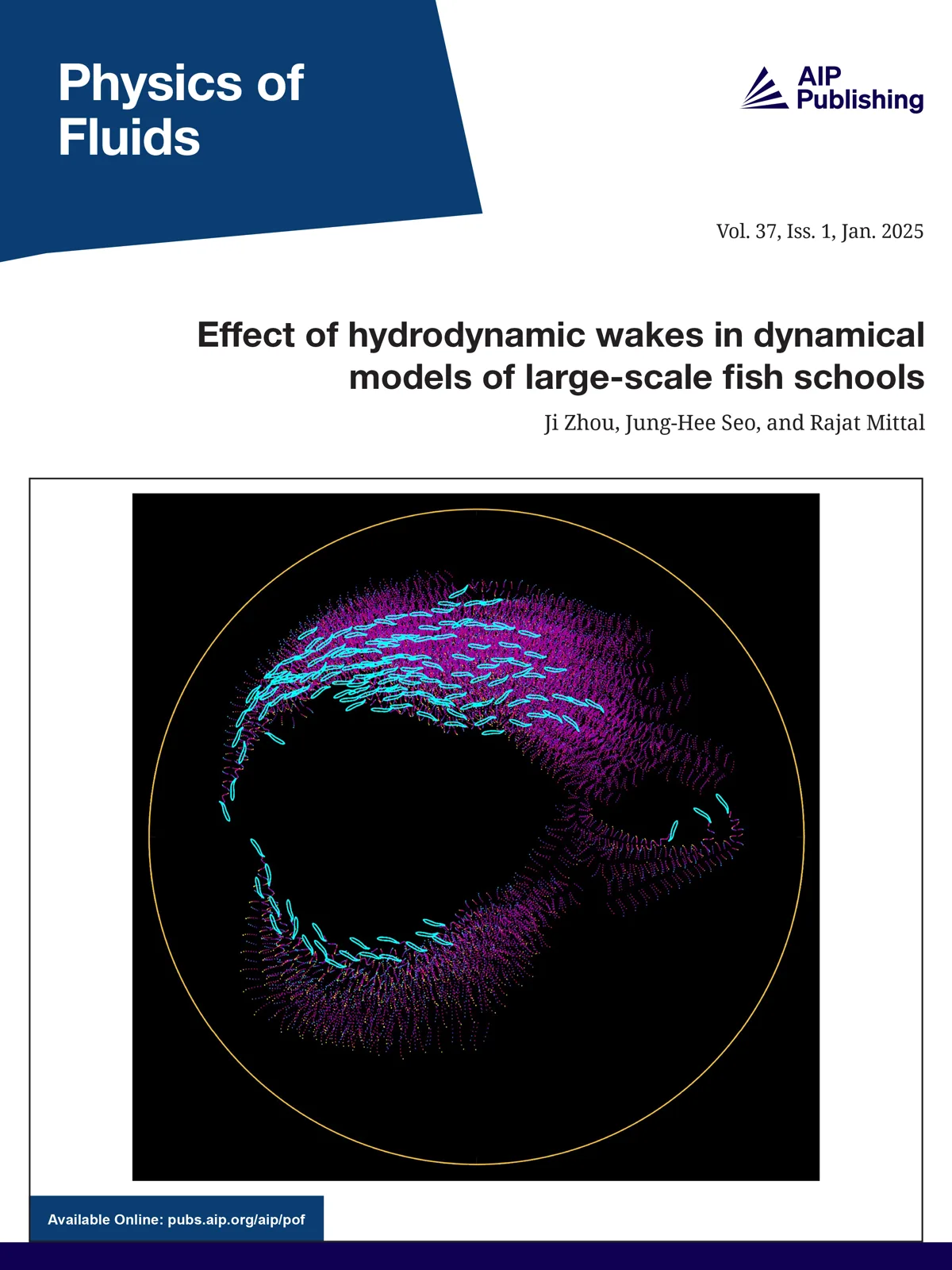
Physics of Fluids - cover articleEffect of hydrodynamic wakes in dynamical models of large-scale fish schools
Wake-coupled model development, numerical experiments, and analysis.
NeurIPSActSort: An active-learning accelerated cell sorting algorithm
Domain-informed features, data curation, benchmarking, and evaluation.
[Click to zoom in]Fish schooling[Click to zoom in]
Physics-informed agent-based-model[Click to zoom in]
Selected work
Fluid dynamics, collective behavior, and scientific machine learning.
Projects range from direct numerical simulation of swimming and schooling to physics-informed multi-agent modeling and active learning.
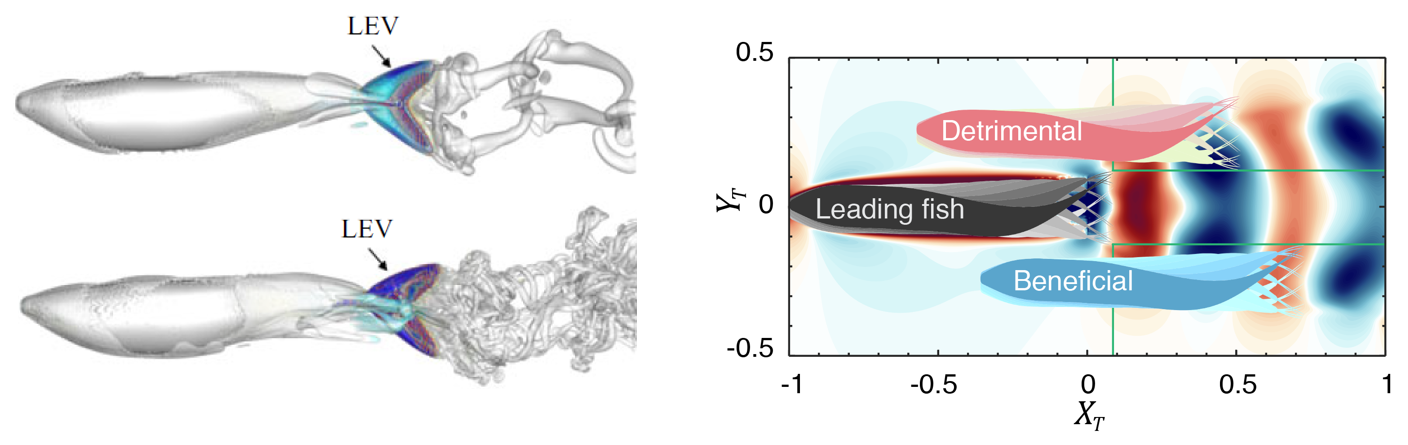
A wake-based model predicts where a trailing fish can gain up to 20% more thrust—without running a new high-fidelity simulation—turning complex schooling hydrodynamics into a practical map for efficient swimming and underwater-vehicle design.
Research role
Simulation design, geometric and kinematic model development, high-performance computing, flow analysis, and manuscript preparation.
Fish wakes do more than trail behind a school: they actively improve organization, especially when social attraction and alignment are weak. The model reveals how fluid physics can help a large group cohere even when behavior alone is not enough.
Research role
Model formulation, implementation, numerical experiments, parameter analysis, scientific visualization, and manuscript preparation.
Fishnality: "Peaceful"[Click to zoom in]Fishnality: "anxious"[Click to zoom in]
ActSort cuts expert review to just 1–3% of cell candidates while improving curation accuracy, making calcium-imaging datasets with up to a million neurons practical to clean at scale.
Research role
Domain-informed feature design, dataset curation, benchmarking, evaluation, and interdisciplinary interpretation.
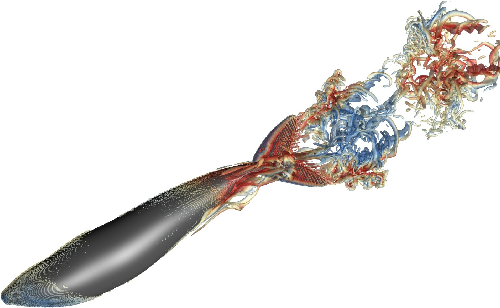
Physics-based scaling laws predict thrust, power, efficiency, cost of transport, and swimming speed from body shape and tail motion—giving researchers and vehicle designers a practical route from observable kinematics to performance.
Research role
Parametric direct numerical simulation, MATLAB analysis, scaling-law validation, and ongoing model development for design-space exploration.
When neighboring fish alternate their tail beats, their sound waves cancel. In the simulations, a seven-fish school could sound like a single swimmer—an acoustic-stealth benefit that may help fish avoid predators and inspire quieter underwater vehicles.
Research role
Study design, simulations, acoustic analysis, and manuscript preparation.
From resolved flow physics to interpretable models of collective behavior.
My current research centers on computational physics and collective behavior. The underlying modeling tools may also support future problems in autonomous systems and bio-inspired robotics.
FOUNDATION
Physics-resolved systems
Biological locomotion, hydrodynamic interactions, acoustics, direct numerical simulation, and scaling.
TRANSLATION
Interpretable computational models
Domain-informed features, reduced-order dynamics, active learning, and uncertainty-aware evaluation.
POTENTIAL APPLICATIONS
Autonomous and bio-inspired systems
Transferable ideas for coordination, interaction-aware modeling, and control in multi-agent systems.
Methods
Immersed-boundary direct numerical simulationPhysics-informed agent-based modelingScaling and reduced-order modelingActive-learning researchCFD → FW–H acousticsLarge-scale simulation workflowsMATLABFortran/MPI solver experiencePythonScientific visualization